Peer-reviewed research by Trieu Hai Vo in deep learning for environmental time series, water-quality monitoring, and physics-informed machine learning.
2025
ICLR-W
Lake Water Temperature Modeling Using Physics-Informed Neural Networks
Trieu H. Vo, Cuong V. Nguyen, Dongsheng Luo, and Leonardo Bobadilla
In ICLR 2025 Workshop on Tackling Climate Change with Machine Learning, 2025
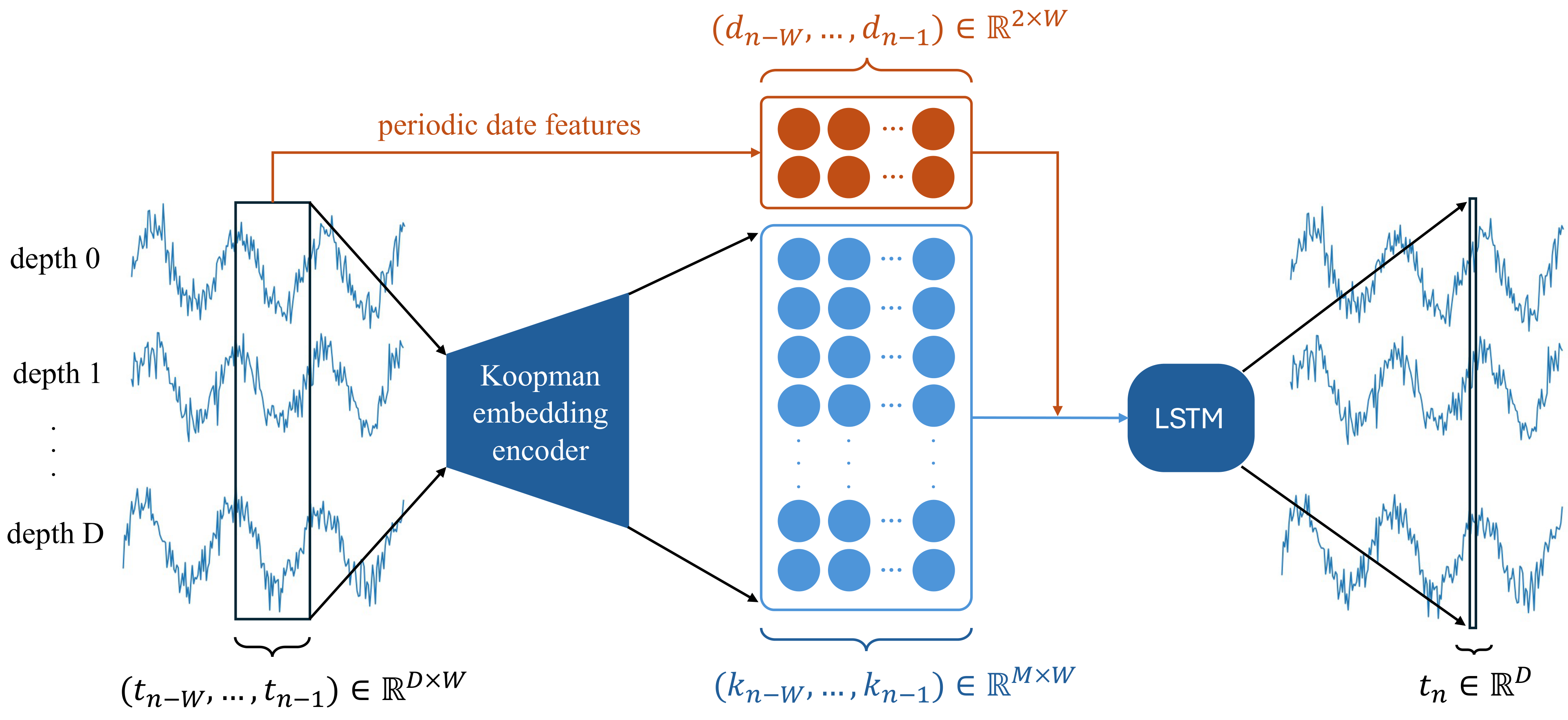
Assessing water quality in bodies of water is important in evaluating the effects of climate change and its anthropogenic impacts. Such assessments often require good models of key indices such as water temperature, pH, or oxygen levels. In this work, we investigate time series models for lake water temperatures at multiple depths and develop a physics-informed neural network based on Koopman embeddings and LSTM that is capable of forecasting water temperatures in the long term. Experiment results show that our model can achieve a good performance and significantly outperforms the conventional LSTM model for this time series forecasting problem.
@inproceedings{vo2025lake,title={Lake Water Temperature Modeling Using Physics-Informed Neural Networks},author={Vo, Trieu H. and Nguyen, Cuong V. and Luo, Dongsheng and Bobadilla, Leonardo},booktitle={ICLR 2025 Workshop on Tackling Climate Change with Machine Learning},year={2025},url={https://www.climatechange.ai/papers/iclr2025/48},}